
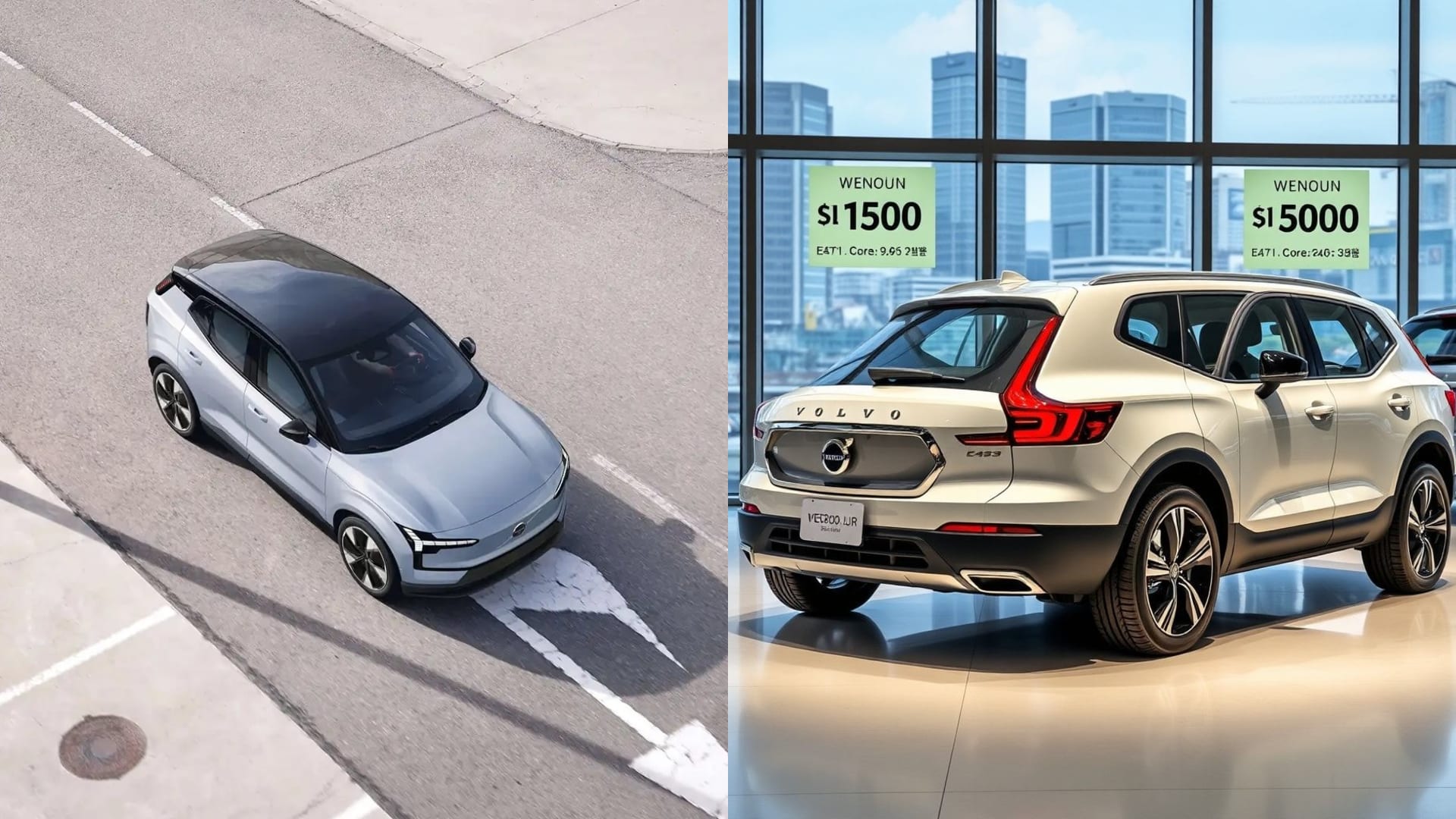


Volvo reduces prices for the EX30 and EX30 Cross Country in Korea by up to 7.61 million won, with subsidies further extending the drop. See the new values and impacts.
Neste artigo
Volvo cuts EX30 prices in Korea with subsidies
Volvo Cars announced price cuts for the EX30 and EX30 Cross Country sold in South Korea, with reductions of up to 7.61 million won. The discounts take effect from March 1st, amid slow demand and increased competition from Chinese manufacturers.
The EX30 Core now costs 39.91 million won, down from 47.51 million won, representing a 16% drop. The EX30 Ultra and EX30 Cross Country Ultra will see reductions of 7 million won each, with prices of 44.79 million won and 48.12 million won, respectively.
With Seoul's government subsidies applied, the effective prices drop even further. The EX30 Core can almost reach 36.7 million won, while the Ultra stands at about 41.58 million won, and the Cross Country Ultra at approximately 42.54 million won.
These subsidies are relevant because South Korea's electric vehicle support structure requires prices below 53 million won for full access to benefits—a threshold that all three EX30 variants meet after the cuts.
Lee Yoon-mo, CEO of Volvo Cars Korea, explained that the decision to apply discounts followed intense discussions with the headquarters. He reinforced the brand's strategy to make premium EVs more accessible: “We expect to lead the popularization of premium electric vehicles through the EX30 and EX30CC, which have price competitiveness, and do our best so that customers can experience the Volvo brand value at a lower cost.”
In the South Korean market, the SUVs compete directly with the BYD Atto 3, the Kia EV3, the Hyundai Kona Electric, and the Tesla Model Y.
In the US, late last year, Tesla reduced prices for certain models: the Model Y Rear-Wheel Drive Premium dropped by up to 3 million won, while the Model 3 Performance AWD saw a decrease of 9.4 million won. These changes show the trajectory of price adjustments in the EV segment.
The reductions position the EX30 against its competitors in Korea, in an increasingly contested EV segment, with Kia and Hyundai also adjusting financing promotions and prices for other electric models:
- Hyundai reduced financing rates for its EV promotion from 5.4% to 2.8%.
- Kia, in January, cut the prices of the EV5 Long Range and EV6 by 2.8 million won and 3 million won, respectively.
EX30: launch, specifications, and availability
The Volvo EX30 was unveiled in June 2023 in Milan, with production in China and Belgium. The electric SUV was launched in November 2023, with deliveries starting at the end of June 2024.
The EX30 Cross Country maintains the same height and wheelbase, but is 1,850 mm wide and 1,573 mm tall. All EX30 versions use a 64 kWh battery, offering EPA estimated ranges of up to 227 miles (Cross Country), 253 miles (Twin Motor), and 261 miles (Single Motor). DC charging reaches up to 153 kW, taking about 28 minutes to go from 10% to 80%.
In Korea, Volvo also offers plug-in hybrid and mild-hybrid versions of models such as the S90, XC60, XC90, as well as the XC40, V60 Cross Country, and V90 Cross Country.
EX30 Recall and US Lawsuit
Last month, Volvo recalled 33,777 units of the EX30 worldwide due to battery overheating risks that could cause fires. The majority of affected units—10,400—were located in the UK, with 40 vehicles reported in the US and other countries.
The manufacturer advised owners of the defective SUVs to limit charging to 70% and to park them outdoors, away from structures, until a permanent solution is implemented.
Also in the US, Volvo faced a class-action lawsuit related to a recall of over 400,000 vehicles, including electric ones, over a rearview camera issue, filed at the end of January.
Meanwhile, the South Korean market is closely watching Volvo's pricing strategies, as it seeks to balance premium brand value and accessibility for new urban customers.
What is your opinion: will the EX30 price reductions accelerate the adoption of premium EVs in Korea, or does the pace of adoption depend on other policies and incentives? Leave your comment below and share your vision for the future of EVs in the region.
Alert: Dongfeng Box gains six airbags without price increase; what changes for buyers?

Toyota bZ sales soar in the US in Q1 2026, surpassing the Chevy Equinox EV

Ioniq 5 defies expectations: sales up 14% in Q1 2026

GM maintains lead in US sales in Q1, with March boosting recovery

IONIQ 5 boosts Hyundai's record March and points to a stronger Q1

Forester Wilderness Hybrid: vegan interior, 12.3-inch digital dashboard, and orange trim