
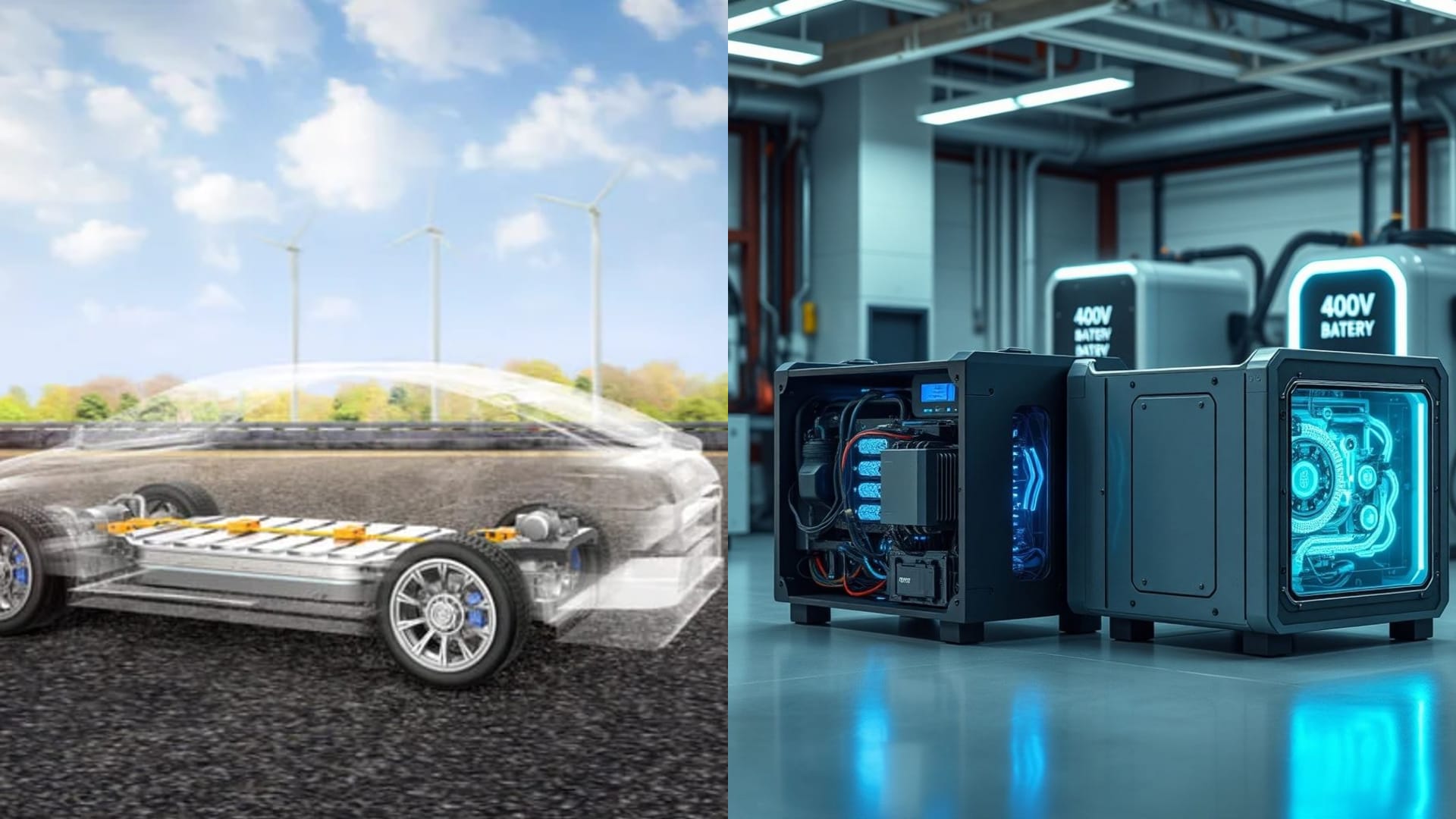


Discover why the 800V architecture can be the engine for EV scalability, reducing current, heat, and costs.
The global automotive industry is rapidly advancing toward mass electrification, and the decisive factor is not cell chemistry, but the battery architecture: 800V.
Practical cases, such as that of Lightning Motors, which leads the production of an 800V motorcycle, indicate that the architecture determines commercial success in the high-performance EV segment.
Neste artigo
1. Capital Efficiency: copper vs. voltage
In 400V systems, speeding up charging requires increasing current, which entails higher costs.
- Heavier BoM: more expensive cables and connectors.
- Thermal overload: more heat requires larger and more expensive cooling solutions.
By adopting the 800V architecture, it is possible to deliver the same power with half the current, paving the way for thinner cables and simplified cooling. The result? higher margins for OEMs.
2. Operational ROI: the “downtime tax”
For commercial fleets and high-use vehicles, time is money. Thermal charging can force the BMS to reduce the charging rate to avoid overheating.
- Frequent derating in 400V.
- 800V sustains charging rates for longer, reducing idle time and increasing daily productivity.
With 800V, there is greater uptime and throughput, which improves the operational efficiency of vehicle fleets.
3. Future-proofing and Residual Value
The market is already divided between generation 1 (400V) and generation 2 (800V+). With the installation of 350kW+ ultra-fast charging infrastructure becoming the norm, 400V vehicles may depreciate quickly.
- High-voltage architecture acts as a hedge against obsolescence.
- 800V vehicles tend to maintain higher resale value by maintaining compatibility with the high-speed grids of the next decade.
The strategic summary: charging speed depends on a complex ecosystem, but the pack architecture is the fundamental element for translating potential into real performance and profit.
Richard Hatfield is CEO & CTO of Lightning Motors Corporation, a leader in high-performance electric vehicle technology. With experience in EV architecture and engineering, he guided Lightning in developing the first production 800V motorcycle.
Which aspect do you think will have the greatest impact on EV scalability: copper cost, generated heat, or package architecture? Share your point of view in the comments below.
Alert: Dongfeng Box gains six airbags without price increase; what changes for buyers?

Toyota bZ sales soar in the US in Q1 2026, surpassing the Chevy Equinox EV

Ioniq 5 defies expectations: sales up 14% in Q1 2026

GM maintains lead in US sales in Q1, with March boosting recovery

IONIQ 5 boosts Hyundai's record March and points to a stronger Q1

Forester Wilderness Hybrid: vegan interior, 12.3-inch digital dashboard, and orange trim