
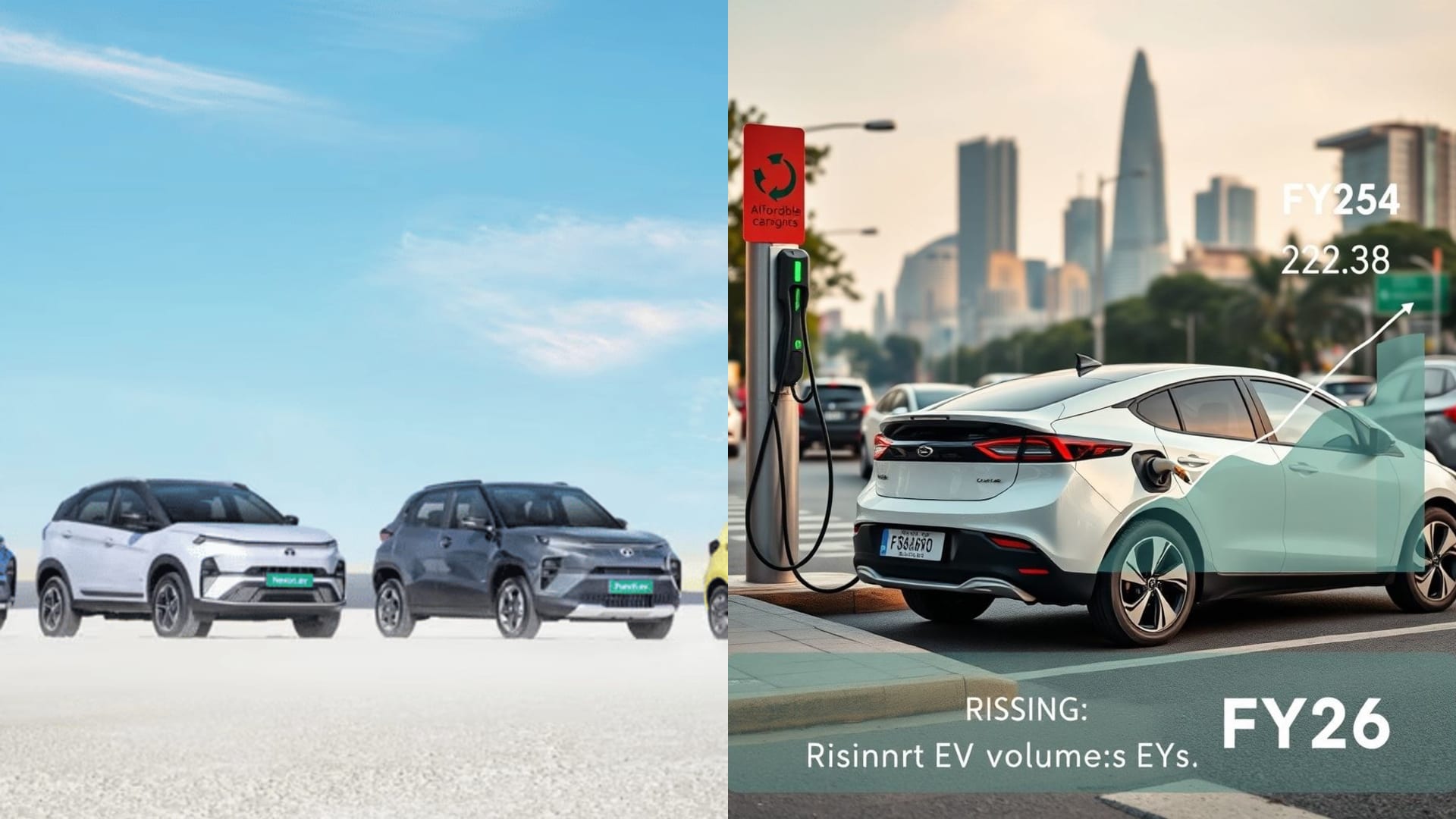


India's EV market may reach 200,000 units in FY26, with 4–5% penetration; the challenge lies in the electrification of the sub-₹12 lakh segment.
Neste artigo
Market Panorama
The electric vehicle scenario in India points to the mark of 200,000 units in FY26, maintaining penetration between 4% and 5% of total passenger car sales.
Where is the momentum?
Although higher price segments are driving growth, the next level depends on the electrification of the mass segment sub-₹12 lakh.
Recent Performance and Key Numbers
Shailesh Chandra, managing director of Tata Motors Passenger Vehicles, highlighted that the first half showed stable growth, signaling consolidation after years of rapid expansion, with EVs increasingly accepted as an alternative to internal combustion engine vehicles in the mid and premium segments. This year, the industry is expected to exceed 2 lakh EVs.
For FY26, the forecast is that the total PV market will reach between 4.5 and 4.6 million units, resulting in EV volumes between 180,000 and 230,000 units, or a penetration of 4–5%.
Disparities Between Price Brackets
In the segment above ₹12 lakh, with about 1.6 million annual units, EV penetration is already around 10% (approximately 160,000 units per year).
In contrast, in the sub-₹12 lakh segment, responsible for about 3 million annual units, penetration is only 1.6%, corresponding to about 50,000 EVs per year.
“This is the real challenge for mass adoption of EVs in the country. If this segment is not electrified, it will be difficult to achieve the goal of EV mainstreaming.”
Growth Prospects and Bottlenecks
Based on the expected market size, FY26 EV volumes suggest 20–30% year-on-year growth compared to FY25, which saw sales in the range of 150,000–160,000.
The entry of all major manufacturers into the EV space is seen as positive, with competition expanding the overall market rather than slowing it down.
Infrastructure and Margins
The expansion of charging infrastructure is considered crucial to enabling the transition: there are about 30,000 public charging points and over 200,000 home chargers in the country.
Although EV margins remain under pressure, Tata Motors claims to be close to parity with the ICE business in passenger vehicles and is willing to sacrifice short-term margins to sustain long-term electrification.
Competition and Positive Signal
The participation of major manufacturers in the space is seen as a positive signal, as greater competition tends to expand the market as a whole, and will not delay it. "The entry of larger players will be beneficial for the country's electrification mission," stated Chandra.
Comments — Leave your view in the comments: do you think mass adoption essentially depends on the electrification of the sub-₹12 lakh segment, or are there other pillars that will also accelerate adoption?
Alert: Dongfeng Box gains six airbags without price increase; what changes for buyers?

Toyota bZ sales soar in the US in Q1 2026, surpassing the Chevy Equinox EV

Ioniq 5 defies expectations: sales up 14% in Q1 2026

GM maintains lead in US sales in Q1, with March boosting recovery

IONIQ 5 boosts Hyundai's record March and points to a stronger Q1

Forester Wilderness Hybrid: vegan interior, 12.3-inch digital dashboard, and orange trim