
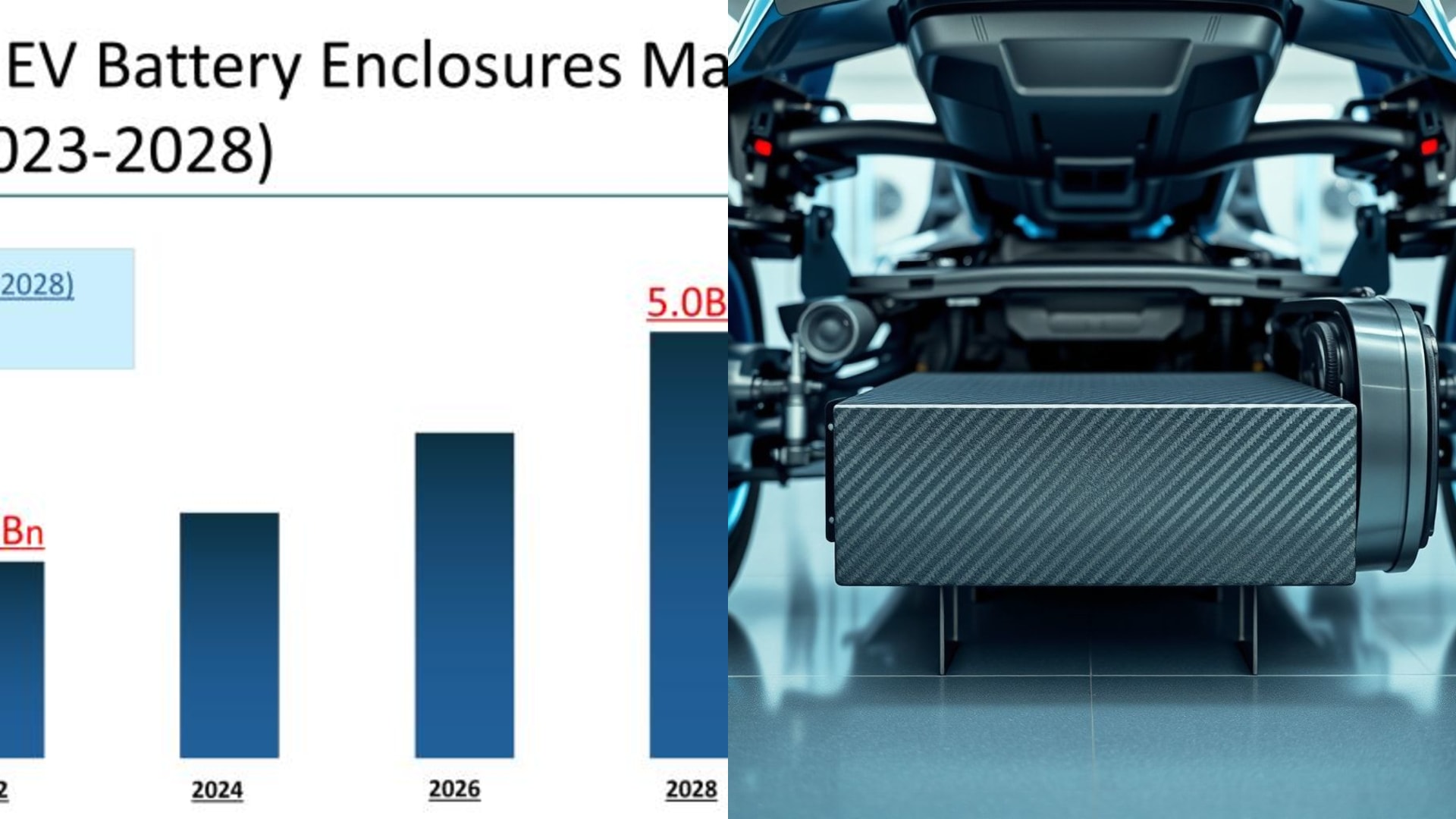


Projection points to accelerated growth in the global market for EV battery enclosures made with composites, driven by BEVs and performance improvement.
The global market for electric vehicle (EV) battery enclosures manufactured from composite materials is projected to rise from approximately USD 0.8 billion in 2022 to USD 5.0 billion by 2030, according to Stratview Research. The annual trajectory stands around 23.5% growth between 2023 and 2030.
The expansion is fueled by the growing adoption of BEVs worldwide, as composites offer weight reduction, corrosion resistance, and superior thermal performance compared to metallic alternatives, positively impacting vehicle range and efficiency.
Neste artigo
Market Summary
- Market in 2022: ≈ USD 0.8 Billion
- Forecast for 2030: USD 5.0 Billion
- CAGR (2023-2030): 23.5%
- Forecast Period: 2023-2030
- Base Year: 2022
- Total Number of Segments: 5
- Tables and Figures: 100+
- Assessment by Country: 20
Market Segmentation
- By Propulsion Type: BEV, HEV
- By Vehicle Type: Passenger Car, Light Commercial Vehicles (LCVs), Medium and Heavy Commercial Vehicles (MHCVs)
- By Composite Type: Glass Fiber Composites, Carbon Fiber Composites
- By Process Type: Compression Molding, Others
- By Region: North America, Europe, China, Rest of Asia-Pacific, Rest of the World
Segment Dynamics
Among propulsion types, BEV remains the dominant and fastest-growing segment, driven by higher adoption, expansion of charging infrastructure, and government incentives, which elevate the demand for advanced encapsulation solutions.
In terms of vehicle type, passenger cars account for the largest share, with increasing consumer awareness, regulatory incentives, and infrastructure expansion supporting supply programs aligned with passenger car OEMs.
Regional Outlook
China is expected to remain the largest regional market through 2030, benefiting from the presence of major BEV manufacturers, robust manufacturing infrastructure, and the strategic position of composite enclosure suppliers.
Market Drivers
- Growing adoption of BEV, driving the use of composite materials to enhance range and efficiency
- Government incentives and regulations promoting EV adoption
- Performance advantages of enclosures, including corrosion resistance and thermal insulation
- Expansion of charging infrastructure reducing barriers to BEV adoption
- Increasing motorization rates and investments in EV production capacity
Key Players
- Continental Structural Plastics (Teijin Automotive Technologies)
- CpK Interior Products Inc (Stellantis subsidiary)
- EMP Tech Co., Ltd.
- Gestamp
- Hanwha Group
- Katcon SA de CV
- SGL Carbon
- STS Group AG
Frequently Asked Questions
- What will be the market size by 2030? R: Approximately USD 5.0 billion.
- What is the projected CAGR from 2023 to 2030? R: Approximately 23.5% over this period.
- Which propulsion type drives the highest demand? R: BEV (Battery Electric Vehicles).
- Which vehicle type represents the largest share of demand? R: Passenger Cars.
- Which region is expected to dominate the market? R: China by the end of the forecast period.
Reader Invitation
How do you see the role of composites in the evolution of EVs in the coming years? Leave your comment below and share if you think the adoption of BEVs will continue to accelerate this battery enclosure niche.
Alert: Dongfeng Box gains six airbags without price increase; what changes for buyers?

Toyota bZ sales soar in the US in Q1 2026, surpassing the Chevy Equinox EV

Ioniq 5 defies expectations: sales up 14% in Q1 2026

GM maintains lead in US sales in Q1, with March boosting recovery

IONIQ 5 boosts Hyundai's record March and points to a stronger Q1

Forester Wilderness Hybrid: vegan interior, 12.3-inch digital dashboard, and orange trim